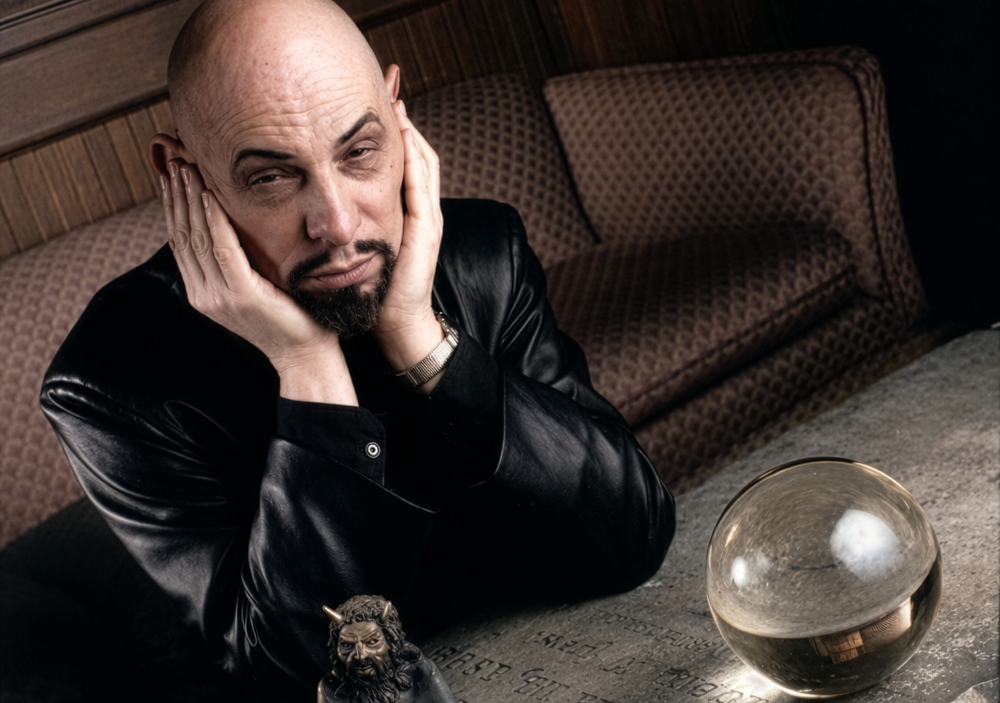
Let me make this very clear... Never! Now let's say it again... Never! Third time's a charm... Never!
I cannot count how many times I've watched someone plant their "Satanic" flag in an argument by declaring, "Well, Anton LaVey would hate that," or "He would never support this," or my personal favorite, "He's rolling in his grave right now." Every single time, my eyes roll so hard I worry they'll get stuck facing backward. Why, in Satan's name, would anyone have the audacity to speak on behalf of a man they never met, never spent any real time with, and never actually knew? Especially when that man is sadly unavailable to confirm or deny whether you're right, wrong, or just making things up to win an internet argument?
And let's talk about "rolling in his grave" for a second, because that phrase deserves its own special place in the Hall of "Nonsensical" Satanist Statements (yeah, I just made that up!). Are you even a Satanist? We don't believe in an afterlife. There is no ghostly Anton LaVey spinning in circles six feet under, outraged by your opinions on synthwave music or a badly reviewed documentary. If you're invoking spectral disapproval from beyond the grave, you might want to double check which philosophy you're actually practicing.
Since Dr. LaVey's death, I have watched an endless parade of people invoke his name to validate their personal opinions, feelings, grudges, and pet peeves, despite never having known him or known him well enough to make such claims. And the list of subjects people claim he'd have strong feelings about is almost comically staggeringly, specific genres of music, particular films, an essay someone wrote, the current Church of Satan administration, computers, technology in general, artificial intelligence, data centers, politicians, government policy, bagels from Paris, and yes, that one judgmental moth that has taken up permanent residence on my wall, silently critiquing my every move. I promise you, Anton LaVey did not have a documented opinion on my moth. Nobody does, not even the moth.
The problem isn't just that these claims are annoying, it's that they're epistemically hollow. There is a very real difference between interpreting something Anton LaVey actually wrote and pretending to know how he would have reacted to something that didn't exist during his lifetime. If you want to say, "Based on this passage in The Satanic Bible, I interpret Anton LaVey's stance on such and such as..." that's a legitimate exercise in textual analysis. There's actually a third category worth mentioning here too, one that sits comfortably between honest interpretation and shameless speculation, documented historical fact. If Anton LaVey said something specific, on record, in an interview or writing, and you're simply repeating that quote, you're not interpreting anything, you're just relaying what already happened. But the moment you slide into, "He would have hated this new album," or "He'd be disgusted by this AI-generated art," you've left the realm of interpretation and documented fact entirely and wandered into the trappings of pure speculation.
If there's one person on this planet whose words I'd actually trust on the subject of what LaVey might think, it's Magistra Blanche Barton. She's essentially the only living person who spent enough uninterrupted time with him to reasonably speak to his likely reactions, preferences, and philosophy in the moment. She witnessed every side of the man, not just the public persona, and not just the version of him captured in his writings. She saw the real, unfiltered Anton LaVey, day in and day out. If anyone alive has earned the right to say "Anton LaVey would or would not think this," it is her.
I say this as someone who actually met him. I spent time with him. I corresponded with him. And even with those experiences under my belt, I still cannot, in good conscience, claim to have known him well enough to speak for him. You will never hear those words leave my mouth, not once, not ever. My respect for what he built and who he was runs too deep to reduce his memory to a convenient prop for my own arguments. If someone who actually knew him refuses to make that claim, what exactly gives a total stranger the confidence to do so?
So why do people do this? Why the constant, compulsive name-dropping? Ironically, it usually comes down to a failure of the very principles Satanism is supposed to be about, individualism, personal responsibility, and critical thinking. When someone has a strong opinion built on shaky facts (facts received from a third-party source without real research), or an emotional reaction they can't quite justify with evidence, they still feel the need to convince everyone else that they're right. Rather than doing the harder work of building an actual argument with documented facts, they reach for the most convenient authority figure available, the founder of our entire philosophy. It's a shortcut and it's intellectually lazy. It's also more than a little ironic coming from people who claim to champion self-reliance and rational thought, yet outsource their conclusions to a deceased man's imagined opinion rather than doing the thinking themselves. Satanism, at its core, asks you to be your own knowledgeable authority (study not worship), to trust your own judgment enough to defend it without needing a the signature of approval from someone who cannot speak for themselves. Borrowing Anton LaVey's name isn't just lazy, it's a bold confession that you don't actually trust your own opinion to survive scrutiny on its own merits. If your argument needs a ghost speaker, maybe it's worth asking yourself why.
There's also a sneaky rhetorical advantage baked into this tactic, and a psychological one too. When you invoke Anton LaVey's name to back your claim, you're essentially making an unfalsifiable statement. Neither you nor the person you're arguing with actually knew him, so neither of you can definitively prove or disprove what he "would have" thought. That unprovability becomes a strange (and weak) kind of shield, which in turn soothes your own uncertainty. There's something oddly reassuring about attaching your fragile, half-formed opinion to a towering figure who can't argue back, correct you, or embarrass you by disagreeing. It's the philosophical equivalent of clutching a stuffed animal for confidence during a thunderstorm, except the stuffed animal is a lifeless body and the thunderstorm is a Facebook argument about whether Anton LaVey would have liked this or not. The name-dropper gets to feel validated, because hey, they dropped the name of the founder himself, and the burden of disproof lands entirely on the other person, who has no more access to Anton LaVey's hypothetical opinions than they do, as he is literally unreachable for comment. Convenient, isn't it?
So, when should you speak for Anton LaVey?
Let's say it together one more time for the people in the back: Never!
So What Do We Do About It?
Now, knowing all of this, how should we actually respond when someone starts name-dropping LaVey to prop up their weak argument? The simplest and most effective response is one phrase: Prove it.
Ask them directly. Which specific writing of his supports this claim? Point me to the passage. Which interview, on record, addresses this topic? Give me a date, a source, something tangible. Did you personally have a conversation with him where he expressed this exact sentiment, and if so, can anyone corroborate that? Has one of the very small number of people who actually spent any large amount of real time with him, people like Magistra Barton, High Priest Gilmore, or High Priestess Nadramia, ever confirmed this interpretation? If the answer to all of these is no, then what you actually have is not an informed statement about Anton LaVey's beliefs. What you have is your own opinion, presented as though it carries Anton LaVey's authority simply because you don't trust your own argument to stand on its own.
It's also worth pointing out, especially to the person on the receiving end of this tactic, that rejecting someone's unsupported appeal to Anton LaVey doesn't mean you're obligated to defend whatever modern subject they're arguing against. You don't have to defend the album, the AI art, the Church of Satan's administrative decision, or, for the record, my moth's questionable life choices. You simply have to point out that invoking the hypothetical opinion of a founder who is no longer here to clarify it isn't a substitute for an actual argument. The goal here isn't to win by silencing the other person, it's to drag the conversation back toward evidence, personal accountability, and genuine critical thought, the very things Satanism values in the first place.
So the next time you hear someone claim to know exactly what Anton LaVey would think, feel, or do about something he never lived to encounter, don't just nod along because they used his name. Ask them to prove it! Hell, ask for their credentials, do they have a Ph.D. in LaVey-thoughtism? No? Then at that point, they've usually fallen off their soap box and sprained their brain on the way down, and the conversation can finally return to something worth having, their argument, standing on its own, without the unknown opinion of a great man they never met propping it up and hoping it will stand without any actual facts to support it.